

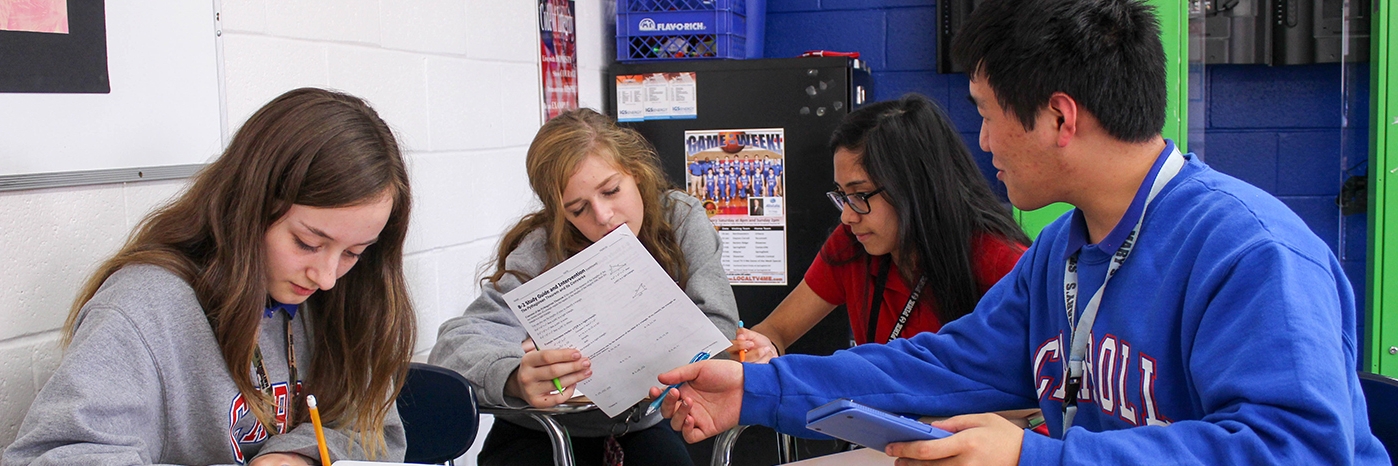
A student is assigned to a Mathematics program that best fits his/her ability level and considers previous Mathematics experiences and future needs in each student's STEM Education. Algebra I, Geometry, Algebra II, and Pre-Calculus are offered at several levels, all of which provide college preparatory work. Levels will differ in degree of abstraction, pace of instruction, and the degree to which a student is expected to work on their own.
Calculators, software, and other technology are necessary for Mathematics education today. They make important mathematical ideas available to students at earlier ages, make possible the use of real-life numbers and graphs in realistic problem situations, and facilitate open-ended problem exploration. Graphing calculators introduce students to the technology used by professional mathematicians, scientists, and engineers. They enable students to visualize complex mathematical functions. Graphing calculators may be used by students taking the SAT, ACT, AP, and other standardized tests. In addition to learning to use graphing calculators, students may have the opportunity to use technological tools such as Geometer’s Sketch Pad, Infinity software and hardware, and FANUC industrial robots and programming software. These technology tools are used to strengthen the comprehension of mathematical foundations and encourage critical thinking for solving problems in a variety of STEM Education applications.
Algebra IA 101/102
Prerequisite: Recommendation from Guidance Department
First semester topics include solving equations in one variable, solving inequalities in one variable, and basics of functions (notation, function language, graphing, etc.). Second semester topics include the study of functions, systems of linear equations and inequalities, and polynomial expressions and functions.
Algebra IB 101/102
Prerequisite: Algebra IA
First semester topics include quadratic functions, radical expressions and radical equations. Second semester topics include exponential functions and equations and statistical modeling.
Algebra I 101/102
Prerequisite: Recommendation from Guidance Department or teacher recommendation
This course emphasizes the underlying structure of the Real Number System and the understanding and application of Algebraic concepts. Topics to be studied include signed numbers, solution of linear equations in one variable, polynomials, factoring, rational expressions, rectangular coordinate system and graphing, and systems of linear equations.
Geometry 201/202
Prerequisite: Algebra I or Algebra IB
This course introduces the basic concepts and relationships of geometry. Students learn to use deductive and inductive reasoning and apply postulates and theorems to geometric figures. Topics to be studied include properties of angles, lines, polygons, ratio and proportion, circles, area, perimeter, coordinate geometry, and volume. Algebra skills are reinforced throughout the course.
Algebra II/Trigonometry 301/302
Prerequisite: Geometry
This course extends concepts and skills learned in first year Algebra, especially equation solving and graphing. Topics to be studied include linear equations, quadratic and higher order polynomials, complex numbers, systems of equations, graphing, conic sections, and trigonometry.
Pre-calculus 401/402
Prerequisite: Algebra II/Trigonometry
Students will review and extend their understanding and application of Algebra I and Algebra II/Trigonometry concepts. In addition, polynomial, trigonometric, and logarithmic functions will be discussed. The conic sections will be explored. As time permits, polar coordinates, sequences, series, and the concept of limits may be discussed.
Scholarship Track
Scholarship Algebra I 101/102
Prerequisite: Recommendation from the Guidance Department
The first semester of this course covers properties of real numbers, functions, solutions of linear equations in one variable, and the Cartesian coordinate system, along with graphing. Many types of problems are explored, with emphasis on developing equations to express relationships between variable quantities, performing correct solution procedures, and clearly expressing conclusions. The second semester covers linear inequalities, systems of linear equations and inequalities, rational exponents, polynomials and factoring, and radical expressions. Statistics and probability topics will be included, as time permits.
Scholarship Geometry 201/202
Prerequisite: Scholarship Algebra I or teacher recommendation
The first semester of this course includes the study of angles, lines, and polygons. Students are led to an appreciation of the need for mathematical proof and will learn to construct original proofs of various types. Second semester topics include circles, right triangles, ratio and proportion, area, perimeter, volume, and coordinate geometry.
Scholarship Algebra II/Trigonometry 301/302
Prerequisite: Scholarship Algebra I and Scholarship Geometry with a 2.0 or above or teacher recommendation
This course extends concepts and skills learned in first year algebra, especially equation-solving and graphing. First semester topics include linear equations and linear systems, matrices, quadratics and higher order polynomials, complex numbers, and rational exponents. Second semester two topics include right triangle trigonometry, the unit circle, and graphing trigonometric functions. Additionally, logarithmic and exponential functions are explored.
Scholarship Pre-calculus 401/402
Prerequisite: 2.0 or above in Scholarship Algebra II/Trigonometry or teacher recommendation
This course prepares students for the study of calculus. Algebra and geometry are integrated with new topics by an approach which stresses analytic geometry, the concept of function, and the axiomatic structure of algebra. Students are introduced to the standard language and symbols of college math. First semester topics include real and complex number fields, plane analytic geometry, algebra of functions, graphing techniques, and periodic functions. Second semester topics include trigonometry, polynomials, exponential and logarithmic functions, vectors, polar coordinates, and sequences and series with an introduction to limits.
Honors Calculus 401/402
Prerequisite: Scholarship Pre-Calculus or teacher recommendation
This course will cover an introduction to differential calculus. First semester topics include limits, derivatives, and applications of differentiation. Second semester topics will focus on integration and applications of integration.
Honors Track
Honors Algebra 101/102
Prerequisite: Recommendation from Guidance Department
This challenging course covers the solution of linear equations and inequalities in one variable. Problems of many types are explored with emphasis on collection and analysis of data, choice of efficient solution procedures, and clear presentation of results. Topics to be studied include the real number system, matrices, introductory set theory, statistics, formulas, analytic geometry, quadratic equations and graphs, functions, systems of equations and inequalities, exponents and radicals, polynomials and factoring, proportion, and rational expressions. Rectangular coordinate system and graphing are stressed throughout the course.
Honors Geometry 201/202
Prerequisite: A full year of Algebra I in 8th grade and teacher recommendation or unweighted 2.5 or above in Honors Algebra I
This challenging course covers mathematical reasoning and proof, angles, polygons, reflections, transformations, congruence, and area and perimeter. Algebra is integrated with geometry. Coordinates and transformations are used in both two and three dimensions. Other topics covered include surface area, volume, coordinate geometry, similarity, indirect proof, introductory trigonometry, and circles. Applications and problem solving are stressed.
Honors Algebra II/Trigonometry 301/302
Prerequisite: Unweighted 2.5 or above in Honors Geometry or teacher recommendation
This fast-paced course stresses algebraic computational techniques and problem-solving skills. Topics to be studied include linear equations and inequalities, relations and functions, graphing, systems of equations and inequalities, polynomials, factoring, rational expressions, complex and irrational numbers, quadratic equations and functions, conic sections, exponential and logarithmic equations, sequences and series, and matrices. Trigonometry topics include angle measure, circular functions, trigonometric graphs, identities and solution of triangles.
Honors Pre-calculus 401/402
Prerequisite: Unweighted 2.5 or above in Honors Algebra II/Trigonometry
This course prepares students for work in calculus, discrete mathematics, and statistics. Students generate problem statements, use a variety of techniques to solve problems, and interpret their solutions. First semester topics include data analysis, curve fitting, and elementary functions. Second semester topics include trigonometric functions, complex numbers, mathematical modeling, combinatorics, vectors, polar coordinates, and series.
Advanced Placement Calculus AB 401/402
Prerequisite: Unweighted 2.5 or above in Honors Algebra II/Trigonometry and Honors Pre-Calculus. Student must apply for acceptance into course.
This course covers the normal content of a first-year college course in calculus, stressing both traditional techniques and technology intensive problem-solving methods. Students will prepare for the Advanced Placement test in Mathematics of the College Entrance Examination Board (CEEB). After a review of functions, graphing, and analytic geometry, the student studies limits, slope of a curve, and the formal definition of derivative. First semester topics include differentiation formulas, implicit differentiation, applications of the derivative including related rates and optimization problems, curve sketching, and the indefinite integral. Practical applications to physics, biology, and economics are included. The second semester covers the definite and indefinite integral, applications of integration, differentiation and integration of trigonometric, exponential, and logarithmic functions, hyperbolic functions, infinite sequences, and series.
Electives
Finite Math 401/402
Prerequisite: Algebra II/Trigonometry
This course will explore various applications of mathematics in social, financial, health, environmental, and other fields with emphasis on developing informational, technological, logical, and visual reasoning skills. Topics from numeracy, probability and statistics, finance, mathematical modeling with linear, statistical, and exponential functions, and other areas of mathematics will be covered.
Engineering and Robotics Topics
Prerequisite: Algebra II/Trigonometry
This STEM course covers topics of logic and linear algebra with emphasis on algorithmic exploration through programming languages. Topics covered include functions, number systems, game theory, and cryptology. This course will also introduce students to various robotics and engineering topics while using actual industrial equipment and control devices to provide a better idea of engineering concepts. Mathematics and science topics will be integrated into the class showing the significance and usefulness of theoretical topics. Students will work both in groups and on their own to complete course objectives.
Honors Engineering and Robotics Topics
Prerequisite: Unweighted 2.5 or above in Honors Algebra II/Trig or Scholarship Algebra II/Trig with teacher recommendation
This STEM course will introduce students to robotics and engineering topics. The focus of this course is to introduce students to actual industrial equipment and control devices to give them a better idea of what robotics entails. This course will also provide the opportunity to practice research, modeling, and communication. The scientific and engineering methods for problem solving will be taught. Students will work both in groups and on their own to complete course objectives.
Advanced Placement Computer Science Principals
Prerequisite: Completion of Honors Computer Science Principles with at least an unweighted 2.5 or Engineering Topics, Honors Engineering Topics, or Statistics or teacher recommendation
This STEM course will capture important aspects of the work that a computer scientist engages in at the level of competence expected of the AP Computer Science Principles student. The students will develop computational artifacts and analyze data, information, and knowledge represented for computational use. Students will learn to collaborate to build computation artifacts and communicate their purpose. By the end of the course, the students will create one of the two required performance tasks, which require students to create computations artifacts though programming. This course will prepare students for the AP Computer Science Principles Test.
Scholarship Statistics and Probability 101/102
Prerequisite: Successful completion (2.0 or better) of Scholarship Algebra II/Trigonometry or above
Students will study the mathematics of probability; they will collect, analyze and interpret data; and they will hone skills in communication and presentation of data-driven results. Students will develop critical thinking skills as they encounter real-world data in this Information Age. This course aims to equip students with the skills to make important insights and to make good decisions as consumers and world citizens. First semester topics of study include basic data analysis such as graphical displays, summary statistics, lines of best fit, use of the Normal curve, exponential and power models. Second semester topics of study include data collection such as sampling, polls, surveys, observational studies, experiments and simulations; probability basics such as counting strategies, probability rules, Venn and tree diagrams, expected value and binomial probability and inference concepts.
Honors Statistics
Prerequisite: Unweighted 2.5 or above in Honors Algebra II/Trigonometry; or Scholarship Algebra 2/Trigonometry with teacher recommendation.
This course introduces students to the major concepts and tools for collecting, analyzing, and drawing conclusions from data. Students will be exposed to the explanation of data patterns, planning a statistical study, the use of models using probability and simulation, and statistical inference.
Advanced Placement Statistics
Prerequisite: Unweighted 2.5 or above in Honors Statistics
This course is a continuation of Statistics. Graphical and numerical techniques will be employed to analyze patterns and departure from patterns. Using statistical inference, well-developed plans will be synthesized to obtain valid information on a conjecture and to select appropriate models for study. Probability will be used as a tool for anticipating what the distribution of data will look like for a given model.
Department Faculty
Mrs. Mary Ollier, Chair
M. Ed. Educational Administration, University of Cincinnati
Mr. Tony Stefanek '89
B.S. Business Finance, Wright State University
Mrs. Ashley (Dunham) Bowers '14
B.S. Applied Mathematics, Marshall University
Mrs. Elizabeth Emser
M.S. Educational Leadership, University of Dayton
Mrs. Cecilia Grosselin
B.S. Mathematics Secondary Education, University of Maryland
Ms. Sarah Lesiak
B.S. Education, University of Dayton
Mrs. Alexis Barnhart
M. Ed. Secondary Mathematics, Xavier University